
BLOCK 03
The letter has a significant role in role in every aspect of our life We still depend on letters as a
means of communicating our professional, business, or consumer interests. Letters use to
express our point of view, make a case, and register an opinion and a need. Therefore it is required to be precise, formal, friendly, and polite in terms of language and style.
USE A FORMAL STYLE
- In the case of a formal letter, we have to use the formal style in terms of language and conventions.
- The language of a formal letter differs from the informal letter which we send to friends and family.
- In a formal letter normally do not use slang and colloquial expressions like “guy”, “bloke”, “I was cheesed off” as we use in formal letters.
- The language of formal language is entirely different from the language which we use in day-to-day life.
Now let’s have look at the difference between the expressions that are used in formal and informal letters.
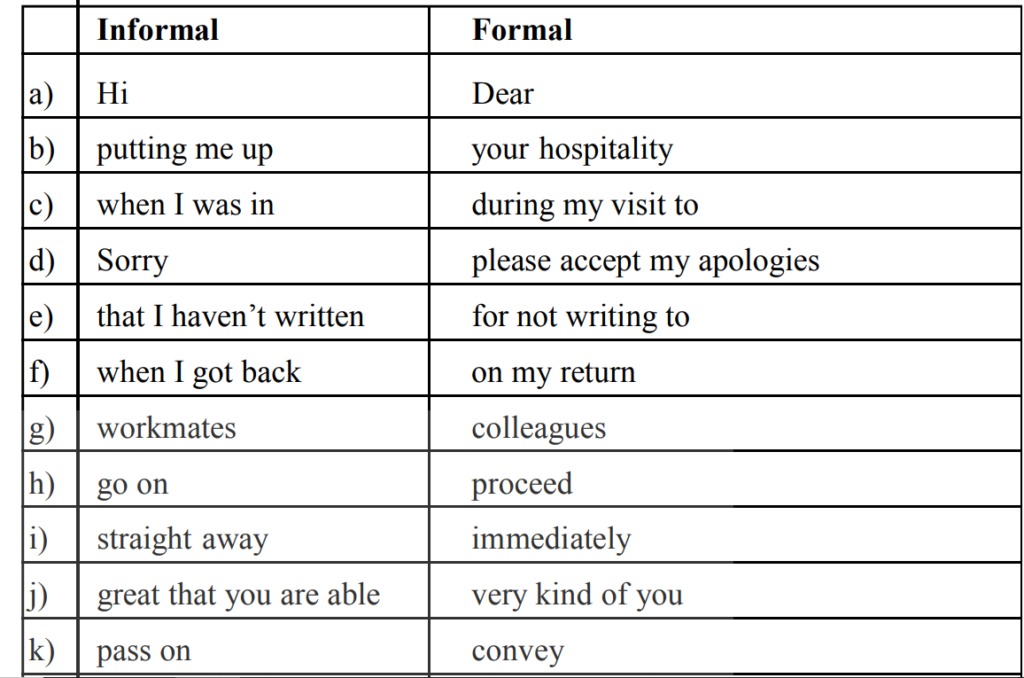
TAILOR YOUR STYLE TO GET RESULTS
In formal letters, we have to use a formal style in terms of language. But we cannot always depend on the formal style, sometimes we have to change based on the purpose of the letter and the relation with the receiver. Style means the way how we use words, phrases, and expressions to communicate with people in different contexts. On some occasions, we have to use the following styles: a forceful style, a passive style, a personal style, and an impersonal style.
A Personal and Friendly Style
Sales promotion letters from banks, credit card companies, and shopping malls use language which is personalized. It has to use words and expressions that reflect friendliness. It makes the reader feel good and doesn’t sound like a computer-generated routine letter.
Use pronouns like I, we, you, your, and my in our letters. It enhances readability and creates a feeling of one human being talking to another. However, the use of personal pronouns like I and you, may not sound proper in a letter of complaint.
Impersonal and Indirect Style
In writing bad newsletters, it is better to use an impersonal and indirect style. Especially in the context of refusing permission, declining requests, or making complaints..
MAKE YOUR LETTERS GENDER NEUTRAL
Making the letter gender-neutral is one of the best practices in letter writing. When we do not know the receiver’s gender and name, it is better to unspecify the gender of the receiver. There is a way to make our letters our letters gender-neutral.
Avoid sexist language; Sexist language is a type of language where we use male pronouns like, he, his, and himself to refer to men and women. It is safer to use the plural pronoun (they, their, themself) or to use both pronouns he/she, him/her, himself/herself, or use you, in your letters. It is considered as a non-sexist language
There are different words that can be used for avoiding sexist language. For example:- Human resources can be replaced by manpower, mail carrier can replace mailman, and chair or chairperson can be replaced chairman. We now commonly use salesperson or sales representative to replace a salesman or saleswoman.
It is very important to be a gender-neutral one unless you are not sure about the receiver of your letter